
2026 Finalists
Mantas Kresninkevičius (LT)
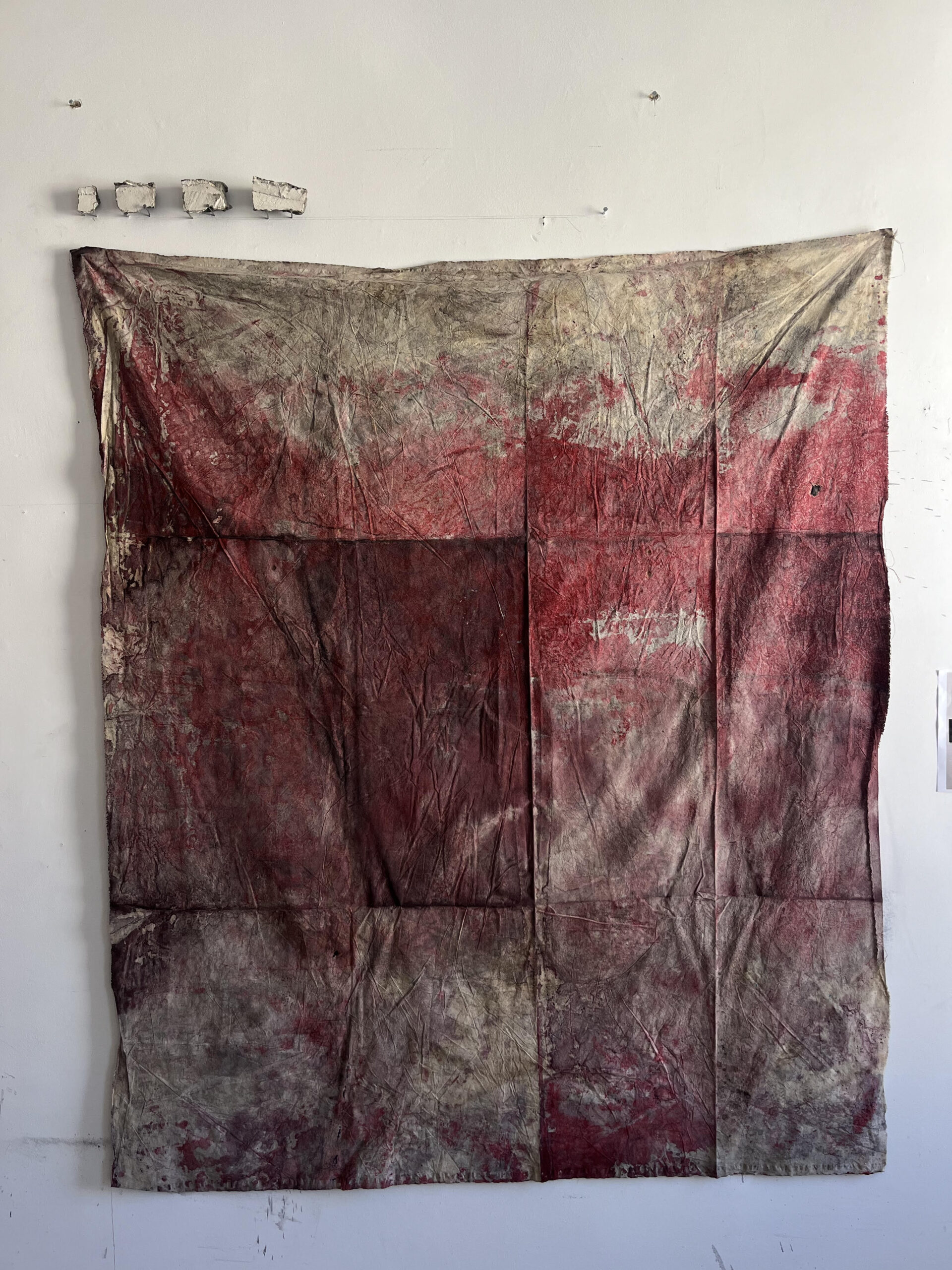
Unfolded
150x120cm / mix media / 2025
Unfolded emerged from thinking about artistic process not simply as image-making, but as a
practice grounded in attention, repetition, duration, and sustained engagement with material. In this
work, I am less interested in the final image than in everything that accumulates through its making:
touches, folds, tensions, stains, and the marks left by time. The surface does not illustrate anything
directly; instead, it preserves the history of its own becoming.
The work developed through a continuous cycle of folding, soaking, covering, leaving and
returning to process. It was important for me to allow the material to remain active rather than fully
submitting to my intentions. For this reason, Unfolded is not conceived as a finished composition in
the traditional sense. Instead, it unfolds as a field of traces where not only the outcome, but also
everything that happened between the beginning and its present state, remains visible. The act of
unfolding becomes more than a physical gesture – it reveals what usually stays hidden: compressed
time, accumulated layers, and the memory of repeated actions embedded within the material.
The place where the work was made is also an essential part of it. My studio is located in a
building that once served as a convent. For me, this is not simply a historical detail but a condition
that shapes my relationship to the space itself. The stones incorporated into the work, collected from
the building, are not intended as symbols. Rather, they function as witness – a material continuity of a
place where prayer, discipline, and contemplative work now unfolds. This overlap raises a question
that has become central to my practice: can artistic process today become a form of spiritual practice –
not in religious sense, but as a way of remaining present through attention, uncertainty, resistance, and
the slow emergence of meaning.
For this reason, Unfolded does not ask the viewer to decipher a fixed meaning. Instead, I hope
the act of looking becomes an act of slowing down – a willingness to remain with something that does
not reveal itself immediately, but gradually begins to resonate through its surface, scale, fragility, and
silence. My intention is not to explain, but to create the conditions for an experience that might, even
briefly, interrupt the profane ways of seeing and open space where material presence and inner
experience can meet and resonate.
(18/25)
