
2026 Finalists
Brenda Purtsak (ES)
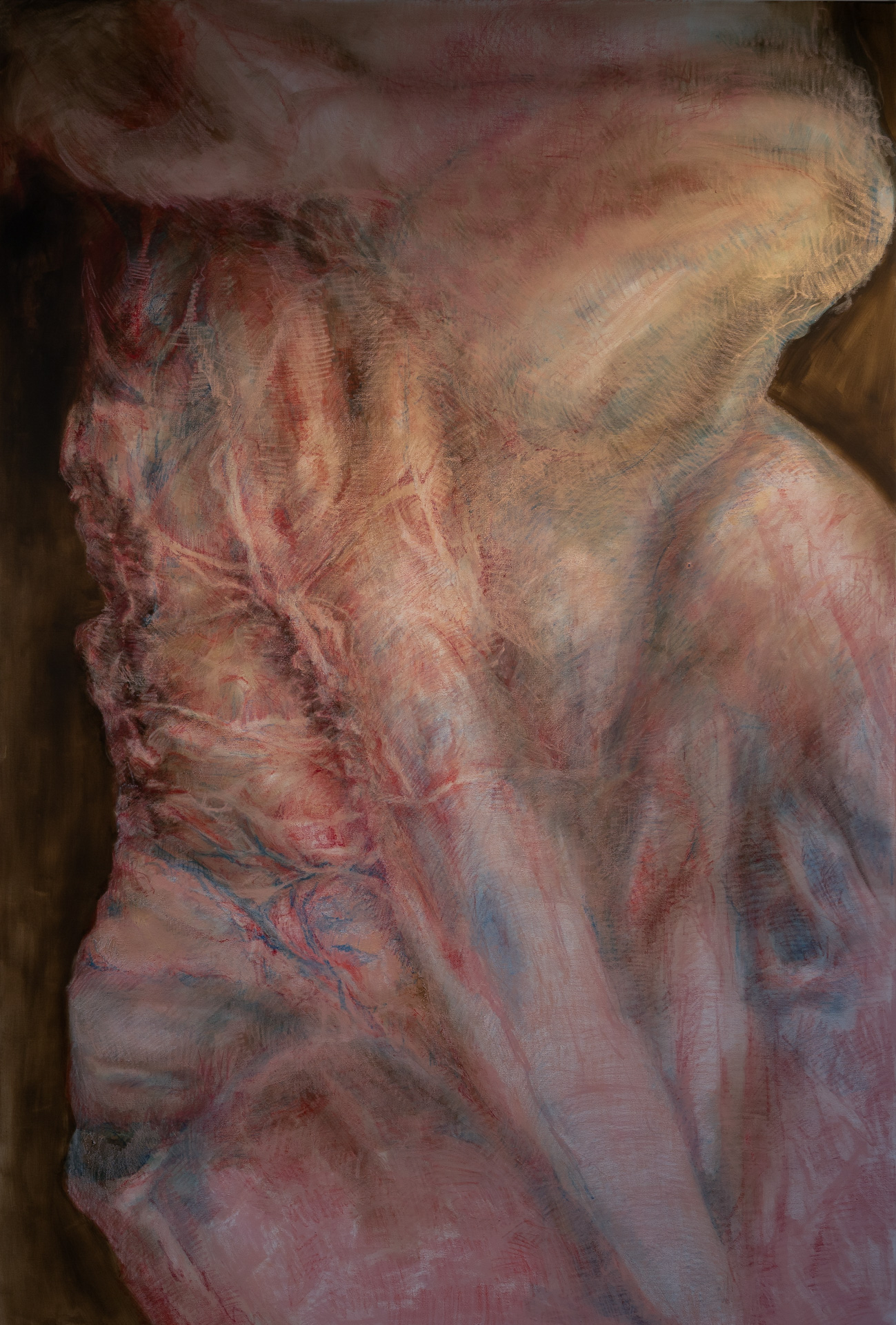
Incision
280x190cm / oil and oil stick on canvas / 2024
Again and again, I return to you.
To me, the biological body is more than an anatomical object. It is a landscape through
which I make sense of the world around me and of myself. Looking at adipose tissue, I
recognize the same formations that appear in clouds; from certain angles, organs resemble
stones shaped by a fast-flowing stream, while blood vessels branch like rivers across a
landscape. Within the biological body lies an entire universe and the origin of human
existence. The longer I observe the body, the less I perceive a boundary between the human
being and nature.
This understanding resonates with the philosopher Maurice Merleau-Ponty, who wrote that
“The body is our general medium for having a world.” The body is not merely an object to be
observed, but the very means through which the world becomes experience. For me,
painting is an attempt to understand this experience, moving alternately into and out of the
body until the boundary between the two begins to dissolve.
When painting the body, the canvas becomes an intuitive field of possibilities that
communicates with me in its own way. Every line and every surface carries its own
roughness or tenderness, bringing the external world into the deepest corners of my inner
life and back again. At times, it reveals emotions and images that I do not yet fully
understand or know how to articulate. Painting is my way of listening to the body before
language catches up with it.
Confronting the body on the surface of the canvas awakens within me a Romantic poet who
has no words but only visual fragments and sensations. Pulling apart layers of fat on the
canvas, I can feel the ache of first love; painting the intestines, I encounter my inability to
tame my own animal instincts. Tracing the patterns of a palm, I sense the rhythm of the
music playing through my headphones; cutting through them, I search for the point where
touch begins. The body carries within it the entirety of human experience—both pain and
beauty.
In Thus Spoke Zarathustra, Friedrich Nietzsche writes: “I am body entirely, and nothing
beside… The body is a great intelligence.” This thought accompanies me throughout my
painting practice. The body is not merely an object of representation, but an autonomous
bearer of knowledge, memory, and experience. Often, it feels as though the painting knows
what the body wants to say before I do.
When I first turned to the body as the subject of my work years ago, I was left speechless by
its beauty. All those colours hidden beneath the skin—blues and reds, yellows and greens.
The body contains every hue that a painter could find irresistible. The more I paint it, the less
I perceive it as something closed or self-contained. Rather than provoking distance, it invites
me to look closer. In this way, the body becomes a place where the human being is not
separate from nature, but belongs to it.
(7/25)
