
2026 Finalists
Armine Hayk (LT/ARM)
Kieno duona/Whose Bread
180x430cm / oil on canvas / 2026
WHOSE BREAD / OIL ON CANVAS / 180X430CM / 2026
Kieno duona (Whose Bread) is the most recent work in a cycle I have been developing for three
years, drawn from images observed in everyday domestic life. I am interested in objects that
are constantly around us and, for that very reason, become almost invisible. In them, I recognise
connections between warmth, energy, the earth’s resources, and our dependence on the systems
that sustain daily life. Bread is not depicted directly in this piece – it remains an allusion, a
question: what do we feed on – food, but also information, belief, attention – and by whose
resources, labour, and time do we live?
In my surroundings I see the same objects again and again. The longer I look at them, the less
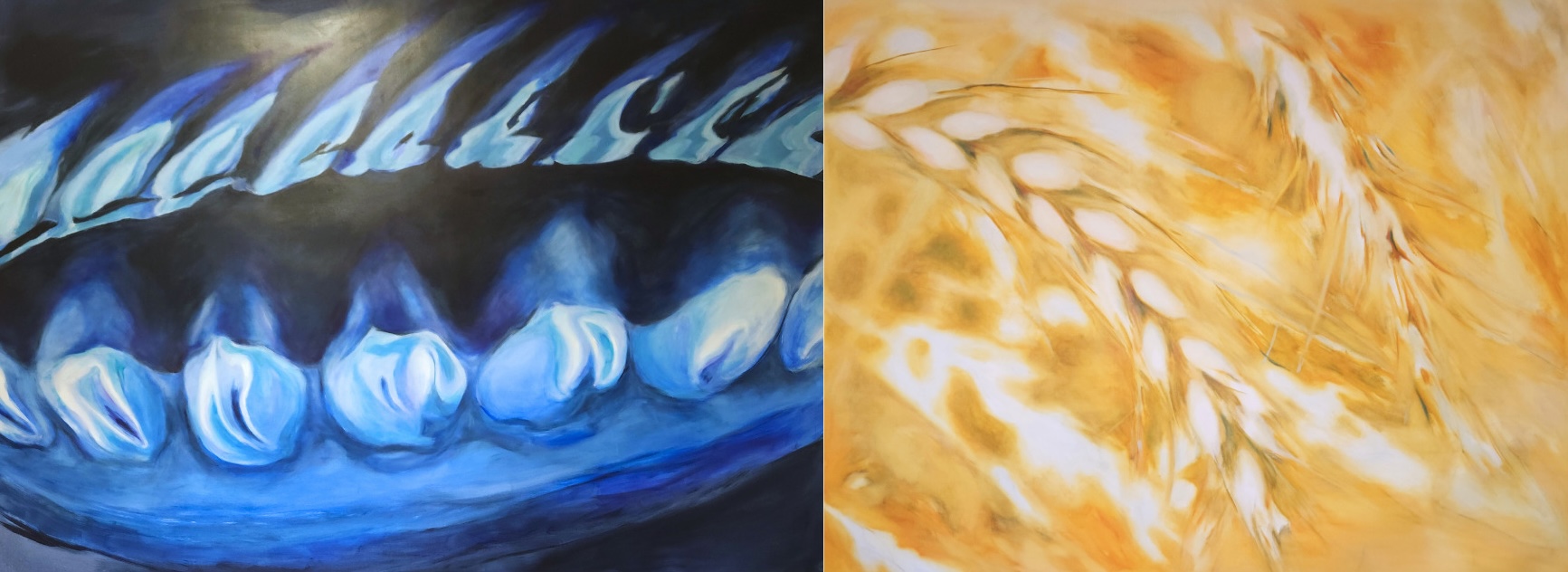
self-evident they become. The flame of a gas stove begins to resemble teeth, a jaw, the depth
of an open mouth. A grain, magnified and frozen in motion, starts to look like a living organism.
To me, these resemblances are not invented metaphors. They arise from the form itself, from
the scale, and from the duration of looking.
The work consists of two images, horizontal in format, their combined length exceeding four
metres. Juxtaposed, they form a single visual syntax: flame and grain, interior and exterior,
warmth and cold meet in such a way that each image is read through the other. Neither is fully
complete on its own – only when placed side by side do they alter each other’s meaning and
force the gaze to move back and forth.
I am not certain whether the resemblance between the flame and the jaw, between the grain
and a living organism, lies in the things themselves or emerges from looking for too long. But
for me, this is precisely the place of painting: not to explain or to prove, but to hold the image
in a state where one thing is still itself, yet already beginning to become something else.
The work is painted in oils, in many thin layers. The slow drying of oil paint here is not merely
a technical property – through it, I try to hold onto the same duration of looking from which
the very observation of these images arose.
The title Kieno duona points to the Lithuanian proverb kieno duona, to ir giesmė – “whose
bread one eats, his song one sings” – the debt owed to whoever feeds, warms, and sustains us.
In this piece, only the conditions of bread are visible: the fire that bakes it, and the grain that
grows, unaware of the fire still waiting for it. Between them remains the question of whose
land, whose labour, whose energy we consume without noticing, each time we simply eat.
(5/25)
