
2026 Finalists
Andris Kaļiņins (LV)
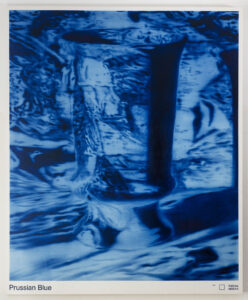
Prussian Blue No. 19
170 × 140 cm / oil on linen / 2026
PrussianBlueNo.19 is structured according to the graphic logic of a traditional artists’
paint sample. Its proportions, white border, colour name and technical symbols frame
the painting as an enlarged colour chart. Yet the central field does not present a
uniform swatch. Through shifts in the density, transparency and darkness of a single
blue oil paint, it produces a still-life image within the very material it displays.
Prussian Blue was accidentally discovered in Berlin around 1706 during an attempt to
produce a red dye. Its discovery coincided with the early years of the Kingdom of
Prussia, and its subsequent use in dyeing dark-blue Prussian military uniforms bound
the pigment to a distinct military visual culture. The painting considers how a pigment
can acquire political charge through its name, history of use and visual circulation. The
battle motif extends this question towards a political order in which military power
shapes culture,representation and everyday forms of visibility.
The work develops this historical charge through the motif of a studio still life. A
projected battle scene illuminates a classical plaster vase, its supporting plinth and the
background wall. The projection determines the composition’s relations of light and
dark. Across the curved surface of the vase and the creased planes of the plinth and
background wall, fragments of soldiers, weapons and movement disperse into an
unstable decorative pattern. A battle scene becomes ornament, while a classical form
is illuminated by military imagery.
Within this logic,the vase and projection are not independent subjects.They are motifs
generated by the pigment and its name. Prussian Blue determines the historical field of
research, the graphic format, the image source and the painting process. The image is
permitted to emerge only through the tonal possibilities of the paint, from luminous
transparent blue to dense, almost black passages. The painting does not resolve into a
fully mimetic image: the battle remains intermittently legible, repeatedly submerged in
the material presence of the paint.
By approaching militarised imperial power through Prussia, the work addresses a
contemporary fear of Russian imperial aggression. Here, Prussia functions as a
historical metaphor for contemporary Russia. Its military and cultural legacy becomes a
lens through which a present threat can be considered.
(3/25)
